Sunday, May 31, 2015

Addison Gallery at Andover


Addison Gallery at Andover


I have often seen works from the Addison Gallery on loan to important exhibits in major galleries.  But it wasn't until May 2015 when the ESA met at Andover that I was able to actually visit this truly fine museum. 

The following overview was provided by the Addison website. The Addison Gallery of American Art has one of he most important collection so American art in the country.  The museum's founding collection included major works by such prominent American artists as John Singleton Copley, Thomas Easkins, Windlow Homer, Maurice Pendergast, John Singer Sargent, John Twachtman and James McNeill Whistler.  Aggressive purchasing and generous gifts have added work by such artists as Alexander Calder, Stuart Davis, Arthus Dove, Marsden Hartley, Han Hofman, Edward Hopper, Georgia O'Keeffee, Jackson Pollock, Charles Sheeler, John Sloan, Frank Stella, Mark Bardford and Kara Walker.  
The Addison's collection of nearly 7,600 photographs spans the history of American photography and includes in-depth holding in key individual artists.

Today, the collection is comprised of more than 17,000 works in all media-painting, sculpture, photography, drawings, prints, and decorative arts- from the eighteenth century to present.


The exhibition I viewed in May featured the art of Alfred Maurer and it did not disappoint!

Alfred Maurer: At the Vanguard of Modernism

April 25 - July 31, 2015

Considered the most accomplished American artist to adopt Fauvism, Alfred Maurer (1868–1932) tirelessly explored the boundaries of artistic expression throughout his career. From his cross-fertilization of Fauvism between French and American circles to his channeling of abstraction in his late radical works, Maurer proved to be a formidable creative force in expanding the potential for artistic expression in American art.
Consisting of over 70 master works, Alfred Maurer: At the Vanguard of Modernism, a major traveling exhibition organized by the Addison Gallery, assesses Maurer’s singular accomplishments and contributions to American painting in the early decades of the twentieth century. Tracing themes that run throughout the full scope of his work, the exhibition illustrates the invaluable contributions this progressive artist made to the development of modernism in America.
While Maurer is often characterized as a painter of divergent, seemingly contradictory aesthetics, careful study of his oeuvre reveals steady interest in thematic ideas as well as formal experimentation with color, form, and abstraction, all of which will be revealed in this significant exhibition. 
Co-curated by independent scholar Dr. Stacey Epstein and Addison curator Susan Faxon, the exhibition will travel to Crystal Bridges Museum of American Art in the fall of 2015.

The video that the Addison prepared celebrating the opening on the exhibition is very instructional.


Click to hear Curator Speaks about exhibition
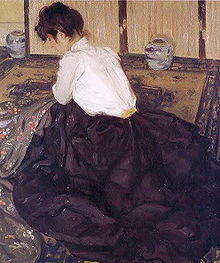
I tend to enjoy more traditions works for some of my favorites were:


The detail and colors were just amazing.  The white of the blouse was amazing as was the use of the red in the second picture.  It seems that Mauer did not name most of his painting, so the titles derive from simple descriptions of each work.

It is always interesting to see portraits of the artist himself and here are a few I found while trying to learn more about this inventive artist.


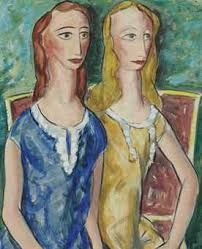
As Mauer moved through his career his work became more abstract as the images of two women show.


His landscapes also show how his art evolved and become more abstract.


While abstract, I so loved the colors that I added them to my favorites.

When I left the Addison Gallery I found that I was deeply jealous of the students and faculty who live next door to this wonderful gallery.  I hope to be able to return to visit it again, but until that time, I will surely make regular virtual visits.


Saturday, February 7, 2015

artists from Mohegan


In an exhbition at the New Britain Museum of American Art, these was a very intesting display of the art of Mr. and  Mrs.  Charles Hamm entitled Over Life's Water: The Coastal Art Collection of Charles and Irene Hamm.  As I walked through the large display of delight art of the sea and coast, I began to notice that many of the either lived on or painted scenes from Mohegan Island.  That encouraged me to create a list of these artists and they explore them as time permited.


Kevin Beers


Samuel Peter Roth Triscott


The artist in the show were 


     James Fitzgerald


      Andrew Winter
     Jay Hall Coonnaway
      Frank Carson
      Leo Brooks
      Guy Corriero
      Robert Henri
      William  Partridge Burpee
      Richard Hayley Lever
      Kevin Beers
      Sears Gallagher
      Samuel Peter Rolt Triscott


Sunday, November 16, 2014

MOMA - Matisse cut-outs


In November it looked as if I would never get to New York to see the Henri Matisse CutOut at MOMA.  I decided to experiment with my ipad and blogster to see if those two technologies would be useful in creating my blog.  Frankly, I found them difficult to master, so I put aside this post and started to celebrate the holidays.  But the elves decide to deliver one more gifts - a trip to NY and MOMA with Harriet.  That trip encouraged me to revisit my original post to see what could be saved using my laptop and blogger.  What follows is the hybred.


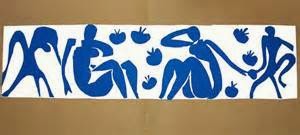
According to MOMA, in the late 1940s Henri Matisse turned almost exclusively to cut paper as his primary medium, and scissors as his chief implement, introducing a radically new operation that came to be called a cut-out. Matisse would cut painted sheets into forms of varying shapes and sizes—from the vegetal to the abstract—which he then arranged into lively compositions, striking for their play with color and contrast, their exploitation of decorative strategies, and their economy of means. Initially, these compositions were of modest size but, over time, their scale grew along with Matisse’s ambitions for them, expanding into mural or room-size works. A brilliant final chapter in Matisse’s long career, the cut-outs reflect both a renewed commitment to form and color and an inventiveness directed to the status of the work of art, whether as a unique object, environment, ornament, or a hybrid of all of these.
Henri Matisse: The Cut-Outs is a groundbreaking reassessment of this important body of work. The largest and most extensive presentation of the cut-outs ever mounted, the exhibition includes approximately 100 cut-outs—borrowed from public and private collections around the globe—along with a selection of related drawings, prints, illustrated books, stained glass, and textiles. The last time New York audiences were treated to an in-depth look at the cut-outs was in 1961.
This exhibition was sparked by an initiative to conserve The Museum of Modern Art’s monumental cut-out The Swimming Pool(1952), a favorite of visitors since its acquisition by MoMA in 1975. The Swimming Pool is the only cut-out composed for a specific room—the artist’s dining room in his apartment in Nice, France. The goals of the multiyear conservation effort have been to bring this magical environment back to its original color balance, height, and spatial configuration. Newly conserved, The Swimming Pool—off view for more than 20 years—returns to MoMA’s galleries as a centerpiece of the exhibition.
With research on two fronts—conservation and curatorial—this exhibition offers a reconsideration of the cut-outs by exploring a host of technical and conceptual issues: the artist’s methods and materials and the role and function of the works in his practice; their environmental aspects; their sculptural and temporal presence as their painted surfaces exhibited texture and materiality, curled off the walls, and shifted in position over time; and their double lives, first as contingent and mutable in the studio and, ultimately, as permanent, a transformation accomplished via mounting and framing. The exhibition also mines the tensions that lurk in all the cut-outs, between finish and process, fine art and decoration, drawing and color. (Taken from the MOMA website, for more information on visiting the exhibition Henri Matisse: The Cut-Outs

 This exhibition was just marvelous.  It rivaled the Sargent show at the MFA.  What follows are some of my favorites.

It is difficult to select favorites - so I am concentrating on new favorites that is to say pieces I was less familiar with.  The range of joyable dancers are simply wonderful.  


One of the real treats was seeing the new restored Swimming Pool.  Many people asked how we felt about the attending such a popular this exhibition - didn't the crowds annoy?  MOMA did a great job managing the crowds and most of the time, all visitors were polite and we shared the space happily.  By the time we go to the gallery displaying the Swimming Pool, we shared the space with one other person.  


Once thing about ignorance is the pleasure you feel when it falls away.  I didn't know or forgot that Matisse did stained glass.  This section of the exhibition was another glorious experience.  As is always the cases pictures can do nothing more than hint, but it does help me remember the experience.


With art like this is a chapel, the visitor know they are in an extraordinary special space.

A trip to an exhibition always ends with a trip to gift shop for postcards and other fun items.  There were two children books on display which made me first think of Ben.  But when I got home, I decided I also needed these books.  So the first title in my new collection of picture books on artist is Matisse's Garden.


Saturday, November 15, 2014

Impressionism in Scotland


While reading book reviews, I discovered that the National Gallery of Scotland was hosting an exhibit entitle American Impressionism: A New Vision. Having visited a number of exhibits last summer on American Impressionism I decided I just needed to go to Scotland to see this exhibit. Fortunately, they had a virtual website which hinted at the possibilities of this exhibit.


"The exhibition traces the discovery of Impressionism by American artists in the late 19th-century. Divided into four groups these include: major figures such as Mary Cassatt, John Singer Sargent and James McNeill Whistler who lived in Paris and were close personal friends of the French Impressionists, especially Degas and Monet; the group of American artists who trained in Paris and/ or settled near Monet at Giverny in 1887; American Impressionists working in the USA, including William Merritt Chase, Childe Hassam and Theodore Robinson and Later Impressionism and the American group known as 'The Ten'."

Some museum sites have many virtual features.  The Scottish site is interesting but not as adventuresome as others.  Nonetheless, there were some wonderful features on this exhibit that I really enjoyed.  Clearly, the sample of art that I was not familiar with was a happy thing.  A sample of these pictures are below.

In the Orchard
Edmund C. Tarbell


Summertime, Mary Cassat

Blossoms at Giverny, Theodore Robinson


Lady Agnew, James McNeill Whistler

Sunday, September 21, 2014

Art in Understated Elegance - Paul Mellon's Collection in New Haven


Yale Center for British Art

In 1966 Paul Mellon give his collection of British at to Yale and had Louis Kahn build a museum to house it in New Haven. Entering the museum is always a pleasure.  The warm wood and light make it easy to put the chaos of the world behind you.

In January the YCBA will close for a year of refurbishing.


Sculpture Victorious: Art in an Age of Invention, 1837–1901

The range of sculptures made this an interesting exhibition.  For me one of the highlight was being able to see Greek Slave by the British sculptor John Bell opposite The American Slave.  It seems just amazing how artists can make bronze and marble come alive.


The Slave Girl or the American Slave,
 John Bell
Hiram Powers, Greek Slave, 1847, marble 


Another of my favorites was Perseus and the Graiae by Edward Coley Burne-Jones.  There was just something wonderful about the texture of this picture/sculpture created using Oil, bronze and silver leaf on carved gesso on an oak panel overpainted with gold..


Perseus and the Graiae


Of course, what's not to love about the Devonshire Perure.

Studying this set with its reset cameos makes you want to go back to the Victoria era for just one evening.

Color, Texture, Design - Art in a Botanical Garden


 Coastal Maine Botanical Gardens

Does the Coastal Maine Botanical Gardens constitute an art exhibition?  If you had asked me before I began my journey to New England art museums to explore a wide variety of displayed art, I would have said no.  However, having developed a broader appreciation of art in a variety of formats, I believe the case can be made that the creators and the ongoing and changing exhibitions at the Botanical Gardens constitute an art installation.

The history of this special place is unusual.  A group of Maine residents conceived the idea for a botanical garden in Boothbay Maine.  In 1996 they purchased 128 acres with funds generated in many cases by loans against the founders' homes.  After some 16 years in planning, digging and planting, the Gardens were opened to the public in 2007. 

Since opening to the public, some 100,000 visitors have toured this outdoor museum - enjoying a variety of environments including  the Lerner Garden of the Five Sense, The Rose & Perennial Garden, The Bosarge Family Education Center, The Bibby and Harold Alfond Children's Garden, The Fairy Garden, The Giles Rhododendron Garden as well as The Vayo Mediation Garden.  


This map gives an indication of the scope of this botanical wonderland,


while the following pictures hint at the case that a group of unique artists using land, flowers, stone and water have created a living work of art for all to enjoy.