Sunday, May 21, 2017

Crystal Bridges
Crystal Bridges - First Stop

My friend Harriet who I enjoy visiting art museums with was planning her sabbatical when the invitation emerged that we travel to Arkansas to visit the Crystal Bridges Museum. The trip was extended to included museums in LA, but at the very heart of the trip was Crystal Bridges. It is such an amazing series of buildings my words cannot do it justice, so here are some pictures which hint at the wonder of the place.


The grounds of the museum are as much a part of the experiences as the museum itself. First afternoon we walked the trails through the woods. Sculptures and flowers were located along the paths.

In the evening we returned to the grounds and we enjoyed the James Turrell: The Way of Color. As the sun sets there is an amazing show which seems to change the color of the sky from blue, to yellow to red through the entire spectrum.


After enjoying the light show provided at The Way of Color, we move on see what delights
Leo Villareal Buckyball had to offer.


Leo Villareal created a sculpture using Led bulbs and computer software to create an ever-changing displays of moving light and color. From our very comfortable wooden and very comfortable lounge chairs we enjoyed another wonderful light show.

After a hardly breakfast at the Cracker Barrel, we returned to Crystal Bridges to see what treasures Alice had collected for us. I'll admit that I was truly giddy as we got our passes - admission to the museum and grounds in free. What a gift to art lovers!
Entering the first gallery gives you a sense of openness, clean lines and light. Every pieces of art enjoys all the space it needs so the viewer can enjoy it without feeling the presence of other art of viewers. Somehow I have never become one to take lots of pictures, I don't like to interrupt my pleasure by constantly pulling out my camera, but hopefully the few I took, will give you a sense of the wonderful gallery spaces.


Sunday, March 5, 2017
Walters Art Museum - Baltimore

The Walters Art Museum is result of the art collecting of father and son William T. and Henry Walters. The collection of over 22,000 works of art from around the world.

Mid February 2017 I decided I needed to escape Connecticut and flee to my Baltimore friends, Wilda and Ed Newman. We started as one always starts a trip to Baltimore - crabs at Timbuktu.

Wilda and I decided that rather than traveling to DC to visit a museum, we would go to Baltimore. Given our time restraint and also the fact that the museum is undergoing some renovation, we decided to concentrate of the top floor where the history of the museum was outlined.
Both of the Walters were very successful business who developed and interest in art collection. In 1931, Henry donated the core collection of the museum to the City of Baltimore. The Museum itself is located in the historic Mt. Vernon Cultural Diction of Baltimore.

 |
| William Thompson Walters |
 |
| Henry Walters |

"William Thompson Walters (1819-94), a native of the village of Liverpool in central Pennsylvania, was drawn to Baltimore in 1841. Initially Walters became a grain merchant, but by 1852 he had established a wholesale liquor house that was to become one of the largest firms of its kind anywhere. Six years later, Walters moved to a house on Mount Vernon Place."
"At about this time, William began to collect art seriously".
"In 1889 Henry Walters moved to Wilmington, North Carolina, to serve as general manager of his father's railroad. Following William's death in 1894, he was elected president of the Atlantic Coast Line Company and transferred the line's headquarters to New York." Henry "lived with Pembroke and Sarah Jones, a couple he had met in Wilmington". He married Sarah three years after Pembroke died.
 |
| The original gallery which is reassembled in the museum |
"As early as 1874 William Walters opened the Mount Vernon Place residence to the public. Every spring, with few exceptions, he continued this civic-minded practice, charging a fee of 50 cents, with the proceeds contributed to charity. Within a decade, when the collection had outgrown the house, he acquired an adjacent property and added a picture gallery."
"When William Walters died in 1894, he bequeathed his collection to his son, Henry Walters, who would follow in his father's footsteps. Henry Walters continued to augment his holdings, buying both in New York and abroad."
"Henry soon had the site of three buildings he had purchased in 1900 transformed in to a palazzo like building, which opened to the public in 1909. He died in 1931, bequeathing the building and its contents to the mayor and city council of Baltimore "for the benefit of the public."


Our visit to the Walters Museum was very brief but I had the sense that it was a well-run progressive museum. The ability to watch and converse with a conservator is just a hint of the innovations.
For that reason I can't wait for the opportunity to visit and explore more of the four floors.

Tuesday, November 1, 2016
Tea Day at Mattatuck Museum

Tea Day 1931: The art Community at Old Lyme
 |
| Edward Volker |
When I saw the announcement for the exhibition at the Mattatuck Museum on life in the Old Lyme Art Colony, I knew I had to return to this small but interesting museum. I invited my friend June and we made the trip to Waterbury. On our way, one wrong turn gave us the chance to tour around the city. Ultimately, we found a parking space and entered the Museum.
The exhibition was inspired by the painting by Edward Volkert which captured the annual garden party hosted by the Lyme Art Association. The show included many old friends as well artists I was not familiar with which is the best mix in any show. What I particularly pleased by the fact that this show included a number of women artists. Below are just a few of my new favorite artists from the show - although the painting are not necessarily the ones on display.
Margaret Miller Cooper

A painter of landscapes, especially of Connecticut, Margaret Cooper Studied at the National Academy of Design and the Pratt Institute in New York and the Pennsylvania Academy of Fie Arts in Philadelphia. In 1935, she moved to Lyme, Connecticut, and painted with artist colony residents William Chadwick and Gertrude Nason.


Bessie Onahotema Potter Vonnoh
A Saint Louis native, Bessie Onahotema Potter Vonnoh produced genre statuettes depicting domestic and feminine subjects that not only captured a refined segment of turn of the century society, but also contributed to the vitalization of small bronze sculpture in America.

Helen Savier Dumond was raised in Portland Oregon but went to New York City to study at the Art Students League. She also studied in France and exhibited at the Paris Salon in 1897 and 1898. She moved with he husband Frank to Old Lyme in 1906.
I simply love the green on her palette.

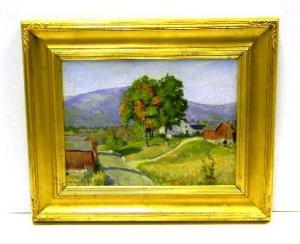
A final walk through of the small exhibition entitled Out of the Shadow: Edwin Augustus Moore. Moore was a talented Connecticut artist who studied at the Art Students League and National Academy of Design. His early art specialized in painting of animals, but later he moved on to watercolors. While never a big fan of portraits of farm animals, I did enjoyed his landscapes.
We ended our day with a delightful lunch at a nearby restaurant.
Wednesday, August 31, 2016
Paris at the Bruce
Paris at the Bruce Museum,
Greenwich, CT

The delightful Bruce Museum in located in Greenwich, Ct. Whenever I think about visiting the Bruce I always weigh the drive down I95 against the potential pleasure of the exhibition. When I saw the announcement of Electric Paris and the website video, I knew I have to take the drive south.

The exhibition displays 50 works by well known reflecting on how lights and lighting can be viewed in Paris at the turn of the 20th century. I have to admit that some of my favorite artists were on display. I suspect that there are many museum goers like myself who travel to shows such as this as an escape of the harshness of our contemporary culture. I am glad there are so many creative curators who can find themes to collect and display the art I find so pleasing.
The show opens with a work by one of my favorite artist John Singer Sargent. His Luxembourg Garden at Twilight captures the theme of the show.


Electric Paris also included more than painting. There were a number of black and white photographs of lamp posts located thoughout Paris which gave one the feeling of the actually walking on the streets.
The exhibition displays 50 works by well known reflecting on how lights and lighting can be viewed in Paris at the turn of the 20th century. I have to admit that some of my favorite artists were on display. I suspect that there are many museum goers like myself who travel to shows such as this as an escape of the harshness of our contemporary culture. I am glad there are so many creative curators who can find themes to collect and display the art I find so pleasing.
The show opens with a work by one of my favorite artist John Singer Sargent. His Luxembourg Garden at Twilight captures the theme of the show.

Ever since I saw a large exhibition on Prendergast at Williams College, he has become one of my favorites. He had one small picture of display but I couldn't find a image of that picture to share. But I can share the work by Alfred Mauer who I discovered in a glorious show at the Addison Galley of American Art on the Phillips Academy campus. Since that experience, I am always pleased when I see yet another of his paintings on display.

Of course, the joy of going to a museum to visit with old friends is not the only reason to seek out various collections. It is always a treat to discover new artists that one is not familiar with. The following are several works that truly capture the spirit of Electric Paris as well as introducing me to new friends.
 |
| Theodore Butler |
 |
| Charles Coutney Curran, Paris at Night |
 |
| Jean-Louis Forain |
While many of the art on the walls were of street scenes, not all. Several that particularly caught my attention and made me applaud the curator's ability to gather a variety of scenes and artists within her topic are shown below.
 |
| Alexandre Lunois |
Electric Paris also included more than painting. There were a number of black and white photographs of lamp posts located thoughout Paris which gave one the feeling of the actually walking on the streets.
The show concluded with a wonderful film clip of Loie Fuller 's Danse Serpertine. This was truly amazing footage which was all the more impressive because Loie designed the lighting with its innovative use of color. After watching Loie dance several times, I left that gallery very glad I came to The Bruce once again and I look forward to my next visit.
 Danse Serpentine


Subscribe to:
Posts (Atom)