Saturday, August 22, 2015

Van Gogh at The Clark

It is always a treat to visit The Clark and when they offer a major exhibition like Van Gogh and Nature, the trip become an extraordinary experience. In late June Jim decided to take me on a trip to celebrate my retirement and also to set the stage for the upcoming golf season. We first went to Saratoga to catch two performances of the NYCity Ballet at the SPA while enjoying all that the Gideon Putnam had to offer. On Sunday morning we headed out of Saratoga Spring to Williamstown with custom packed picnic lunch. We absolutely amazed when we got to Williamstown to find the cars spilled out from the Clark down the road. However, we were fortunate that many people came to the museum early and we were able to find a parking space and then eat our lunch. After lunch Jim headed off to the golf course and I found my way into the museum and the van Gogh in the new gallery.

VAN GOGH and NATURE
The major summer exhibition for the summer of 2015 was Van Gogh and Nature and oh, what an exhibition. It was mounted in the new wing and took up every inch of the gallery space. There were over 50 paintings and drawings supplemented by works of artists such as Monet, Millet and Hiroshige. van Gogh's works are arranged in chronological order. I recognized many old favorites, but many of the work done towards the end of his life were new to me. I was particularly moved by the work in did while in residence in Auvers-sur-Oise. |
| The Yellow House |
 |
| Bedroom in Auers |
The Yellow House and the bedroom are two favorites from period when van Gogh was in Arles.


 |
| Red Poppies with Daisies |
 |
| Parian Novels, 1887 |
Van Gogh did a number of still life paintings. While they are not as special to me as his landscapes, they still a delight the eye. While I am not sure these were on display at The Clark, I think they are unique - especially his books.
The thing that impressed me most about the van Gogh exhibit at the Clark were the number of wonderful paintings that were done towards the end of his life while he was hospitalized. There are absolutely amazing!
 |
| The Olive Trees |

Van Gogh seemed always to have been a prolific painter, but the number of wonderful paintings van Gogh did in his final years is a sure sign of his passion and need to paint. The colors and shapes inspire and delight. However, the last picture in the show and I read somewhere the last picture he ever painted is just about my most favorite. The Rain is simply extraordinary! I just love it as I love The Clark.

Tuesday, August 11, 2015
Hokusai at the MFA

In late June, the Florence Griswold Museum sponsored a trip to the MFA in Boston for the Hokusai exhibition. Although I was unfamiliar with Hokusai's work and not sure how interested I was in Japanese printing making in general, one can not pass up the opportunity to go to Boston and learn about a new artist and art form. My willingness to go outside the box was rewarded. The exhibition included more than 200 work from the MFA's collection by Katsushika Hokusai including the iconic Great Wave. I now know why the art world is so enthusiastic about the work of Hokusai.
Tuesday, July 14, 2015
Connecticut River Museum

CONNECTICUT RIVER MUSEUM - ESSEX, CT
I have spend many a pleasant afternoon strolling down to the base of Main Street in Essex to reach the Connecticut River. On several occasions we have gone into the Connecticut River Museum and enjoyed their nicely prepared historical displays. We also enjoyed the Christmas trains display with the family. Now it seems that the Connecticut River Foundation is expanding its mission and vision of what this museum can offer the community. The Foundation at Steamboat Warehouse was established in 1974 as a small, all-volunteer organization dedicated to preserving the history of the Connecticut River and its people. Today, the museum is a private, not-for-profit, educational institution which recently purchased the Samuel lay House which adjoins the museum property.Mid-June I ventured to the museum with family in tow to discover that the most recent exhibition
NEW DEAL ART ALONG THE THE RIVER
"During the Depression and the early years of World War II, the American Government supported the arts in unprecedented ways. A wide variety of artistic projects were sponsored through the Federal Arts Project. The projects promoted American art and culture and employed thousands of artists." The exhibition at the Connecticut River Museum offered a wonderful sample of the artist who lived and worked along the river.
 |
| Yngve Edward Soderberg, On the Rail |
The cover art for this exhibit was done by Yngve Edward Soderbergh who was born in Chicago, but later settled in Mystic. He was a water colorist and etcher who also created a WPA mural which can be seen at the US Coast Guard Academy in New London.
Certainly, comprehensive exhibitions offered by major museums provide the visitor with a grand experience. But small regional shows can be very worthwhile and positive - as was the art on display in Essex in June. The curator did a nice job collecting art from many Connecticut institutions. Below you'll find some of my favorites.
Certainly, comprehensive exhibitions offered by major museums provide the visitor with a grand experience. But small regional shows can be very worthwhile and positive - as was the art on display in Essex in June. The curator did a nice job collecting art from many Connecticut institutions. Below you'll find some of my favorites.
 |
| Beatrice Cuming, Saturday night, New London |
I'll admit it, I am always on the look out for female artists and to my great pleasure there were a number on the walls in this show. In 1934 Beatrice Cuming relocated from New York to New London and participated in a number of Federal Art Projects. Much of her art is a study of the industrial landscape; however the range of the styles of her work is very exciting as this show revealed.
Harold Barbour was a Higganum artist and spend time painting the scene of the all important tobacco industry in Connecticut. His attention to detail can be seen the two pictures below. Notice that most of the workers appear to be women with male supervisors.


 |
| Beatrice Cuming, Tuna Boad |
 |
| Beatrice Cuming, Industrial Landscape |


Another favorite was done by Corneila Vetter from Haddam who did 18 painting for the Federal Arts project, including the follow painting of her hometown.

Many fine paintings by Connecticut artist who one doesn't normal have access to were on display as shown by the following sample.
 |
| Frank Raymond, Rod Singer's Boat |
 |
| Archie Tillinghast, Gathering Marsh Hay |
 |
| Jerome Stavola, Park Concert |
This exhibit tells the story of life along the Connecticut River and reminds us of the important contribution that the Federal Art Project made in supporting and preserving art during the depression. If this exhibition is any indication of the commitment to expanded the scope of the museum, I will be monitoring their plans for future exhibitions.
Postscription: I found a very interesting article call Art of the Thirties by Arthur D. Hittner. It can be found at http://www.antiquesandfineart.com/articles/article.cfm?request=966 It discussed the masters of the movement called American Scene which flourished during the 1930's.
 |
| Nancy and I outside the museum |
Sunday, May 31, 2015
Addison Gallery at Andover
Addison Gallery at Andover

I have often seen works from the Addison Gallery on loan to important exhibits in major galleries. But it wasn't until May 2015 when the ESA met at Andover that I was able to actually visit this truly fine museum.
The following overview was provided by the Addison website. The Addison Gallery of American Art has one of he most important collection so American art in the country. The museum's founding collection included major works by such prominent American artists as John Singleton Copley, Thomas Easkins, Windlow Homer, Maurice Pendergast, John Singer Sargent, John Twachtman and James McNeill Whistler. Aggressive purchasing and generous gifts have added work by such artists as Alexander Calder, Stuart Davis, Arthus Dove, Marsden Hartley, Han Hofman, Edward Hopper, Georgia O'Keeffee, Jackson Pollock, Charles Sheeler, John Sloan, Frank Stella, Mark Bardford and Kara Walker.
The Addison's collection of nearly 7,600 photographs spans the history of American photography and includes in-depth holding in key individual artists.
Today, the collection is comprised of more than 17,000 works in all media-painting, sculpture, photography, drawings, prints, and decorative arts- from the eighteenth century to present.
The exhibition I viewed in May featured the art of Alfred Maurer and it did not disappoint!

Alfred Maurer: At the Vanguard of Modernism
April 25 - July 31, 2015
Considered the most accomplished American artist to adopt Fauvism, Alfred Maurer (1868–1932) tirelessly explored the boundaries of artistic expression throughout his career. From his cross-fertilization of Fauvism between French and American circles to his channeling of abstraction in his late radical works, Maurer proved to be a formidable creative force in expanding the potential for artistic expression in American art.
Consisting of over 70 master works, Alfred Maurer: At the Vanguard of Modernism, a major traveling exhibition organized by the Addison Gallery, assesses Maurer’s singular accomplishments and contributions to American painting in the early decades of the twentieth century. Tracing themes that run throughout the full scope of his work, the exhibition illustrates the invaluable contributions this progressive artist made to the development of modernism in America.
While Maurer is often characterized as a painter of divergent, seemingly contradictory aesthetics, careful study of his oeuvre reveals steady interest in thematic ideas as well as formal experimentation with color, form, and abstraction, all of which will be revealed in this significant exhibition.
Co-curated by independent scholar Dr. Stacey Epstein and Addison curator Susan Faxon, the exhibition will travel to Crystal Bridges Museum of American Art in the fall of 2015.
The video that the Addison prepared celebrating the opening on the exhibition is very instructional.

The video that the Addison prepared celebrating the opening on the exhibition is very instructional.

Click to hear Curator Speaks about exhibition
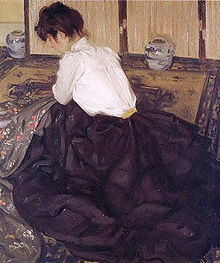




I tend to enjoy more traditions works for some of my favorites were:
The detail and colors were just amazing. The white of the blouse was amazing as was the use of the red in the second picture. It seems that Mauer did not name most of his painting, so the titles derive from simple descriptions of each work.
It is always interesting to see portraits of the artist himself and here are a few I found while trying to learn more about this inventive artist.

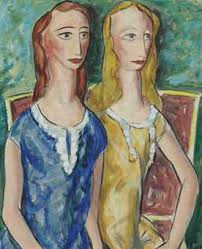
As Mauer moved through his career his work became more abstract as the images of two women show.
His landscapes also show how his art evolved and become more abstract.


While abstract, I so loved the colors that I added them to my favorites.
When I left the Addison Gallery I found that I was deeply jealous of the students and faculty who live next door to this wonderful gallery. I hope to be able to return to visit it again, but until that time, I will surely make regular virtual visits.
Saturday, February 7, 2015
artists from Mohegan
In an exhbition at the New Britain Museum of American Art, these was a very intesting display of the art of Mr. and Mrs. Charles Hamm entitled Over Life's Water: The Coastal Art Collection of Charles and Irene Hamm. As I walked through the large display of delight art of the sea and coast, I began to notice that many of the either lived on or painted scenes from Mohegan Island. That encouraged me to create a list of these artists and they explore them as time permited.

Kevin Beers

Samuel Peter Roth Triscott


The artist in the show were
James Fitzgerald
Andrew Winter
Jay Hall Coonnaway
Frank Carson
Leo Brooks
Guy Corriero
Robert Henri
William Partridge Burpee
Richard Hayley Lever
Kevin Beers
Sears Gallagher
Samuel Peter Rolt Triscott
Sunday, November 16, 2014
MOMA - Matisse cut-outs
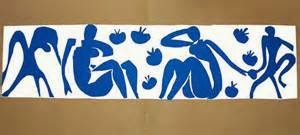
 In November it looked as if I would never get to New York to see the Henri Matisse CutOut at MOMA. I decided to experiment with my ipad and blogster to see if those two technologies would be useful in creating my blog. Frankly, I found them difficult to master, so I put aside this post and started to celebrate the holidays. But the elves decide to deliver one more gifts - a trip to NY and MOMA with Harriet. That trip encouraged me to revisit my original post to see what could be saved using my laptop and blogger. What follows is the hybred.


Henri Matisse: The Cut-Outs is a groundbreaking reassessment of this important body of work. The largest and most extensive presentation of the cut-outs ever mounted, the exhibition includes approximately 100 cut-outs—borrowed from public and private collections around the globe—along with a selection of related drawings, prints, illustrated books, stained glass, and textiles. The last time New York audiences were treated to an in-depth look at the cut-outs was in 1961.
This exhibition was sparked by an initiative to conserve The Museum of Modern Art’s monumental cut-out The Swimming Pool(1952), a favorite of visitors since its acquisition by MoMA in 1975. The Swimming Pool is the only cut-out composed for a specific room—the artist’s dining room in his apartment in Nice, France. The goals of the multiyear conservation effort have been to bring this magical environment back to its original color balance, height, and spatial configuration. Newly conserved, The Swimming Pool—off view for more than 20 years—returns to MoMA’s galleries as a centerpiece of the exhibition.
With research on two fronts—conservation and curatorial—this exhibition offers a reconsideration of the cut-outs by exploring a host of technical and conceptual issues: the artist’s methods and materials and the role and function of the works in his practice; their environmental aspects; their sculptural and temporal presence as their painted surfaces exhibited texture and materiality, curled off the walls, and shifted in position over time; and their double lives, first as contingent and mutable in the studio and, ultimately, as permanent, a transformation accomplished via mounting and framing. The exhibition also mines the tensions that lurk in all the cut-outs, between finish and process, fine art and decoration, drawing and color. (Taken from the MOMA website, for more information on visiting the exhibition Henri Matisse: The Cut-Outs
This exhibition was just marvelous. It rivaled the Sargent show at the MFA. What follows are some of my favorites.
It is difficult to select favorites - so I am concentrating on new favorites that is to say pieces I was less familiar with. The range of joyable dancers are simply wonderful.

This exhibition was just marvelous. It rivaled the Sargent show at the MFA. What follows are some of my favorites.
It is difficult to select favorites - so I am concentrating on new favorites that is to say pieces I was less familiar with. The range of joyable dancers are simply wonderful.


One of the real treats was seeing the new restored Swimming Pool. Many people asked how we felt about the attending such a popular this exhibition - didn't the crowds annoy? MOMA did a great job managing the crowds and most of the time, all visitors were polite and we shared the space happily. By the time we go to the gallery displaying the Swimming Pool, we shared the space with one other person.


Once thing about ignorance is the pleasure you feel when it falls away. I didn't know or forgot that Matisse did stained glass. This section of the exhibition was another glorious experience. As is always the cases pictures can do nothing more than hint, but it does help me remember the experience.


With art like this is a chapel, the visitor know they are in an extraordinary special space.
A trip to an exhibition always ends with a trip to gift shop for postcards and other fun items. There were two children books on display which made me first think of Ben. But when I got home, I decided I also needed these books. So the first title in my new collection of picture books on artist is Matisse's Garden.


Subscribe to:
Posts (Atom)