Tuesday, November 1, 2016

Tea Day at Mattatuck Museum


The Mattatuck Museum


Tea Day 1931: The art Community at Old Lyme


Edward Volker

When I saw the announcement for the exhibition at the Mattatuck Museum on life in the Old Lyme Art Colony, I knew I had to return to this small but interesting museum.  I invited my friend June and we made the trip to Waterbury.  On our way, one wrong turn gave us the chance to tour around the city.  Ultimately, we found a parking space and entered the Museum.  

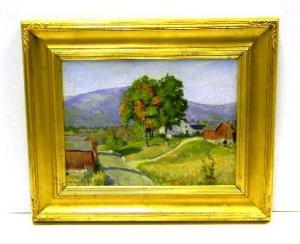
The exhibition was inspired by the painting by Edward Volkert which captured the annual garden party hosted by the Lyme Art Association.  The show included many old friends as well artists I was not familiar with which is the best mix in any show.  What I particularly pleased by the fact that this show included a number of women artists.  Below are just a few of my new favorite artists from the show - although the painting are not necessarily the ones on display.

Margaret Miller Cooper      


A painter of landscapes, especially of Connecticut, Margaret Cooper Studied at the National Academy of Design and the Pratt Institute in New York and the Pennsylvania Academy of Fie Arts in Philadelphia.  In 1935, she moved to Lyme, Connecticut, and painted with artist colony residents William Chadwick and Gertrude Nason.


Bessie Onahotema Potter Vonnoh

A Saint Louis native, Bessie Onahotema Potter Vonnoh produced genre statuettes depicting domestic and feminine subjects that not only captured a refined segment of turn of the century society, but also contributed to the vitalization of small bronze sculpture in America.


Helen Savier Dumond was raised in Portland Oregon but went to New York City to study at the Art Students League.  She also studied in France and exhibited at the Paris Salon in 1897 and 1898.  She moved with he husband Frank to Old Lyme in 1906.  

I simply love the green on her palette.


There were also other artists whose works I enjoyed, including Harry Leslie Hoffman, E. Gregory Smith, Charles Vezin and Ruth Middleton.  June and I also took a quick peak at the famous Waterbury Button Museum which is housed within the MATT.

A final walk through of the small exhibition entitled Out of the Shadow: Edwin Augustus Moore. Moore was a talented Connecticut artist who studied at the Art Students League and National Academy of Design.  His early art specialized in painting of animals, but later he moved on to watercolors.  While never a big fan of portraits of farm animals, I did enjoyed his landscapes.


We ended our day with a delightful lunch at a nearby restaurant.

Wednesday, August 31, 2016

Paris at the Bruce


Paris at the Bruce Museum,

Greenwich, CT


The delightful Bruce Museum in located in Greenwich, Ct.  Whenever I think about visiting the Bruce I always weigh the drive down I95 against the potential pleasure of the exhibition.  When I saw the announcement of  Electric Paris and the website video, I knew I have to take the drive south.  


The exhibition displays 50 works by well known reflecting on how lights and lighting can be viewed in Paris at the turn of the 20th century.  I have to admit that some of my favorite  artists were on display.  I suspect that there are many museum goers like myself who travel to shows such as this as an escape of the harshness of our contemporary culture.  I am glad there are so many creative curators who can find themes to collect and display the art I find so pleasing.


The show opens with a work by one of my favorite artist John Singer Sargent.  His Luxembourg Garden  at Twilight captures the theme of the show.


Ever since I saw a large exhibition on Prendergast at Williams College, he has become one of my favorites.  He had one small picture of display but I couldn't find a image of that picture to share.  But I can share the work by Alfred Mauer who I discovered in a glorious show at the Addison Galley of American Art on the Phillips Academy campus.  Since that experience, I am always pleased when I see yet another of his paintings on display.


Of course, the joy of going to a museum to visit with old friends is not the only reason to seek out various collections.  It is always a treat to discover new artists that one is not familiar with.  The following are several works that truly capture the spirit of Electric Paris as well as introducing me to new friends.


Theodore Butler

Charles Coutney Curran, Paris at Night
Jean-Louis Forain

While many of the art on the walls were of street scenes, not all.  Several that particularly caught my attention and made me applaud the curator's ability to gather a variety of scenes and artists within her topic are shown below.  
Alexandre Lunois

Electric Paris also included more than painting.  There were a number of black and white photographs of lamp posts located thoughout Paris which gave one the feeling of the actually walking on the streets.  

The show concluded with a wonderful film clip of Loie Fuller 's Danse Serpertine.  This was truly amazing footage which was all the more impressive because Loie designed the lighting with its innovative use of color.  After watching Loie dance several times, I left that gallery very glad I came to The Bruce once again and I look forward to my next visit.


                                                                Danse Serpentine


Thursday, July 21, 2016

Lyman Allen Museum - A Visit to Southern Connecticut to Explore Impressionism


The Lyman Allyn Art Museum has been offering its collection to art lovers of Connecticut since 1932.  It has been some time since I visited this handsome neo-classical building, but when I heard about their summer exhibition  A Good Summer's Work: J. Alden Weir, Connecticut Impressionist I knew a trip was required.  My friend June and I set out for New London on a beautiful summer day to learn more about J. Alden Weir and his painting colleagues.  Weir and the art colony based in his studio at his farm painted in western Connecticut for nearly 40 years.  

The exhibition begins with several portraits of Weir and his family.
J. Alden Weir, 1852 -1919


Anna Weir and her husband Alden

Ella Baker Weir, Anna 's Sister. .Ella and Alden married after Anna's death

The exhibition video Love at First Sight makes clear, Alden's Windham Connecticut retreat greatly impacted his work.   The documentary film is very well done and most interesting.


The following are some of pictures that reflects Weir's love for Windham.

Windham Village


 One of Weir most famous painting is picture of a railroad bridge which critic say is influence by the Japanese art that was being studied and purchased by many of the Impressionist painters of the time.

The Red Bridge

Weir's other Connecticut home in Branchville is now the National Historic Site - the first national park dedicated to an American artist.  The Weir Farm National Historic Site was home to several generations of American Artists.  Julia Alden Weir  purchased the farm in 1882 .  Dorothy Weir and husband Mahond Young continue to the artistic tradition of the farm.
It was celebrate in an exhibition at the Bruce Museum entitled


Weir Farm House  on the property of the National Historic Site


The Laundry, Branchville

The Fishing Part

The exhibition also includes the works of other American impressionist.  One of the artist included in this show was Emil Carlsen and was a wonderful discovery.

                   
Soren Emil Carlsen, 1853 - 1932


Night, Old Windham

October  Summer


Another painter I enjoy being introduced to was Guy C. Wiggins.  There seems to be no end to impressionist I can discover.  Life is good!

Church on the Hill


Friday, November 6, 2015

Heritage Museums and Gardens


It is so interesting where you find art when you start looking for it.   The Heritage Museums and Garden, located in Sandwich, Mass, is the largest public garden in Souther New England.  It is a very special place where you can easily spend an afternoon wandering in beautiful gardens and then shift gears and enjoy some fine art or a very impressive collection of vintage automobiles.  

After strolling through the beautiful and well maintained gardens, I arrived at the Special Exhibition Gallery to enjoy:

The Wyeths: America Reflected


The museum write up clearly states the purpose of the exhibition.
        “I want to show Americans what America is like,” Andrew Wyeth once declared. Together with his father N.C. and his son Jamie, Andrew Wyeth has helped to shape how Americans view themselves, their history, and their aspirations. Consisting of works by all three artists, the exhibition The Wyeths: America Reflected will elucidate such quintessentially American themes as: patriotism and the meaning of America; family; the significance of place; and the role of storytelling.

There is no doubt in this viewer's eyes that the Heritage people succeed wonderfully.  Is is easy in a gallery with the three Wyeth gentlemen to be overwhelmed by the classic works of N.C. Wyeth and frankly that happens to a certain degree at the Heritage show.  But N.C. Wyeth's works are so delightful I certainly didn't care. 


 Having said how pleasant it was to see numerous works by NC, I was more that excited when I moved on to explore the works of his son Andrew.  I spent a good hour at this small but delightful exhibitions, but I am afraid I I no longer recall which paintings had been selected.  So below are simply some of my favorite painting by Andrew Wyeth.


There were fewer works by Jamie Wyeth in this exhbitions; and, frankly neither my notes nor my memory allow me to recall which I saw on the July afternoon.  But here are a few of my favorites some of which may or may not have been send in Sandwich.


After spending a considerable part of the afternoon in the gallery, I finished a delightful walk along the garden trails.  Had a wonderful lobster roll in the Windmill Garden.  I think finished the afternoon with a visit to the J. K. Lilly III Automobile Gallery.  I only went into this gallery because I had time.  I was very surprised how interesting I found this robust collection.  Clearly, vintage cars lovingly restored and collected are also true works of art.


Saturday, August 22, 2015

Sailing Ships at the Florence Girswold

Van Gogh at The Clark


It is always a treat to visit The Clark and when they offer a major exhibition like Van Gogh and Nature, the trip become an extraordinary experience.  In late June Jim decided to take me on a trip to celebrate my retirement and also to set the stage for the upcoming golf season.  We first went to Saratoga to catch two performances of the NYCity Ballet at the SPA while enjoying all that the Gideon Putnam had to offer.  On Sunday morning we headed out of Saratoga Spring to Williamstown with custom packed picnic lunch.  We absolutely amazed when we got to Williamstown to find the cars spilled out from the Clark down the road.  However, we were fortunate that many people came to the museum early and we were able to find a parking space and then eat our lunch.  After lunch Jim headed off to the golf course and I found my way into the museum and the van Gogh in the new gallery.

VAN GOGH and NATURE 

The major summer exhibition for the summer of 2015 was Van Gogh and Nature and oh, what an exhibition.  It was mounted in the new wing and took up every inch of the gallery space.   There were over 50 paintings and drawings supplemented by works of artists such as Monet, Millet and Hiroshige.  van Gogh's works are arranged in chronological order.  I recognized many old favorites, but many of the work done towards the end of his life were new to me.  I was particularly moved by the work in did while in residence in Auvers-sur-Oise.


The Yellow House
Bedroom in Auers


The Yellow House and the bedroom are two favorites from period when van Gogh was in Arles.


Red Poppies with Daisies


Parian Novels, 1887

Van Gogh did a number of still life paintings.  While they are not as special to me as his landscapes, they still a delight the eye.  While I am not sure these were on display at The Clark, I think they are unique  - especially his books.


The thing that impressed me most about the van Gogh exhibit at the Clark were the number of wonderful paintings that were done towards the end of his life while he was hospitalized.  There are absolutely amazing!

The Olive Trees


Van Gogh seemed always to have been a prolific painter, but the number of wonderful paintings van Gogh did in his final years is a sure sign of his passion and need to paint.  The colors and shapes inspire and delight.  However, the last picture in the show and I read somewhere the last picture he ever painted is just about my most favorite.  The Rain is simply extraordinary!  I just love it as I love The Clark.