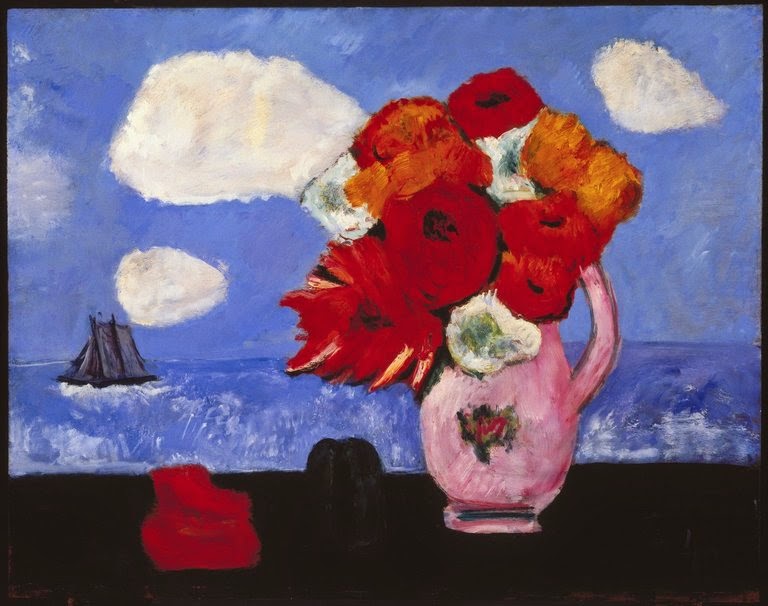
Saturday, July 5, 2014

National Museum of Women in the Arts - A Virtual Tour

As much as I have been enjoying my recent visits to New England museums, at some point I  realized that there were very few women artists in any exhibit I visited.  This reality seemed true almost regardless of the nature or theme of the art on display. This made me wish I could visit the National Museum of Women in the Arts, Washington, DC.  Suddenly, it came to me -  this is the virtual age, so this blog post represents my virtual visit to a very special museum.


As I started my virtual tour, I found it is very different experience to wander through a museum with your fingers than with your feet; however, I realized that learning to effectively visit museum virtual would open up an extraordinary experience to visit art collected through out the world -- what an amazing possibility!

The National Museum of Women in the Arts is such a unique museum; it seems logical to start with a few comments on its history.  The question for this museum is the same one that motivated me create this page, "where are the women artists?"  This question motivated Wilhelmina Cole Holladay and Wallace F. Holladay to make women artist their collecting criteria starting in 1960.  After 20 years, Wilhelmina made her collection the core of the permanent holdings of this new, important institution which opened in the spring 1987.  The following video capture the essence of the NMWA mission https://www.youtube.com/watch?v=L3we9ItJy50

Whenever one enters a museum, the question is always "Where to begin?"   The NMWA's permanent collection boasts 4,500 artworks by more than 1,000 women artists - both well known and lesser known.   Some of the artists represented are Mary Cassatt, Lavinia Fontana, Clara Peeters, and Élisabeth Louise Vigée-Lebrun as well as modern and contemporary artists such as Magdalena Abakanowicz, Chakaia Booker, Jaune Quick-to-See Smith, and Joana Vasconcelos.  I started my virtual tour by sampling works from the permanent collection (http://www.nmwa.org/explore/collection-highlights) which is conveniently arranged by century.  I immediately clicked on 18th - 19th century because this period is familiar.

Marguerite Gerard, Prelude to a Concert, ca 18810

Berthe Morisot, 1885. The Cage

Then I moved on to the 20th century and contemporary art works to look for new favorites.


Elizabeth Adela Stanhope Forbes, Will-o'-the-Wisp, ca. 1900


Alma Woodsey Thomas, Iris, Tulips, Jonquils, and Crocuses, 1969


Joan Mitchell, Sale Neige, 1980
M. L. Van Nice, Swiss Army Book, 1990
Hollis Sigler, To Kiss the Spirits: Now, This Is What It Is Really Like, 1993

This virtual visit to the National Museum of Women Artists fulfilled my desire to see the artistic work by women from around the world.  It also convinced me that the doors of most museums are open to me.  What a wonderful discovered and extraordinary opportunity for future "museuming". 


Saturday, June 28, 2014

The Michele & Donald D’Amour Museum of Fine Arts: A Classical Treasure in Springfield

The Michele & Donald D’Amour Museum of Fine Arts is one of two Springfield Museums dedicated to fine and decorative arts.  Mr. & Mrs. James Philip Gray left their entire estate for the “selection, purchase, preservation, and exhibition of the most valuable, meritorious, artistic, and high class oil paintings obtainable,” and for the construction of a museum to house them. The Art Deco-style museum was opened in 1934.


It is amazing what can be discovered when one takes full advantage of opportunities.  Since I have been exploring the art museums of New England, I have become aware of a wide variety of institutions.  On Friday, I drove up 91N less than an hour from my home to explore one of several Springfield museums which I had never visited.  I suspect that my first visit with Sue, a high school friend, will not be my last.


The exhibit we traveled to see was created by the Brooklyn Museum and included 57 masterworks exploring the artists who defined the development of American art.  Most of the artists found on the walls are well known: Georgia O’Keeffe, Milton Avery, Marsden Hartley, Stuart Davis, Arthur Dove, Rockwell Kent, Elie Nadelman, Reginald Marsh and Norman Rockwell.  The works selected for this show forces the viewer to keep shifting her perspective as each has different tone.  With such variety, it is hard to select a favorite.  But I admit I was pleased to see art by Milton Avery and Marsden Hartley on display.

I have come to think of Milton Avery as painting women as abstract shapes of color, so I was surprised to see a wonderfully, detailed picture of his daughter.  It was a reminder of how artists evolve over time.


Milton Avery.  Artist's Daughter by the Sea 1943 

I am sure that Marsden Hartley has also evolved, but the sample of his art in this exhibit seemed to represent the style one generally associates with him.  And no one could complain as his bright, primitive style is delightful to observe.


Handsome Drinks, 1916
Marsden Hartley (1877-1943)
Oil on composition board


Marsden Hartley (American, 1877-1943). Summer Clouds and Flowers, 1942. Oil on fabricated board


Erastus Salisbury Field 

Historical monument of the American Republic

When entering The Michele & Donald D'Amour Museum you are greeted by broad marble stairs and center atrium.  The archictecture of the interior space announces that many treasures will be found within.

 At the end of the Blake Court, the visitor spies a very large canvas which simply demands a closer inspection.
Historical Monument of the American Republic, 1867-1888 by Erastus Salisbury Field, oil on canvas

Erastus Salisbury Field Historical Monument is a very large (9 feet high x 13 feet wide) is an extraordinary canvas which endeavored to document history of the United States.  It was Field's hope that his vision would ultimately be built.  He plans to raise the funds by exhibiting the painting and providing lectures on his vision.  However, the Field's dream never became a reality.  There is a certain frustration in exploring this work of art because it is very difficult to see the details or understand the symbolism that Field used in his masterpiece.  Below is a sample of the type of images which are the foundation of this fantastical representation of our history. It was originally published in the article Ideology and Rhetoric in Erastus Salisbury Field's "The Historical Monument of the American Republic" by Paul Staiti published in Winterthur Portfolio, Vol. 27, No. 1 (Spring, 1992), pp. 29-43


Sunday, June 22, 2014

The Bruce Museum - American Impressionism and Chinese Contemporary Art


I travelled to Greenwich, Connecticut to see the exhibition Pasture to Pond: Connecticut Impressionism but stayed to enjoy Tales of Two Cities: New York & Beijing.  The Bruce Museum is a delightful small museum which was designed at its inception as a natural history, historical, and art museum.

In the late 1890's  John Henery Twatchtman, J. Alden Weir and Childe Hassam settled in the Cos Cob area, as Connectitcut became the epicenter of American Impressionism along with Old Lyme Art Colony.  "In 1912 the Bruce Museum opened with an exhibition by members of the Greenwich Society of Artists, which included Childe Hassam, Emil Carlsen, Leonard and Mina Fonda Ochtman, Elmer McRae among others. The Museum continued to host the Society's exhibitions until 1926, and acquisitions from those shows form the nucleus of its holdings in Cos Cob Impressionism."  This early history explains why I felt compelled to visit Pasture to Pond.


What's not to love about the works by Hassam or Weir?

J. Alden Weir, (American, 1852-1919)
River Scene Near Norwich, Connecticut, c. 1910
Frederick Childe Hassam (1859-1935)
The Mill Pond, Cos Cob, 1902
Oil on canvas

I also discovered several impressionist I was unfamiliar with -
Charles H. Davis and Frank DuMond to mention two


Charles H. Davis, (American, 1856-1933)
Summer Uplands, n.d.
Oil on canvas


Frank DuMond (1865-1951)  Top of the Hill


Tales of Two Cities

I was pleasantly surprised how interesting I found this exhibit.  My favorite piece was a video called Ink City by Chen Shaoxiong (https://www.youtube.com/watch?v=k2U8Xb-QgCE) which was a ink video installation.  The artist created a video made up of ink drawings which were based on photographs of daily life in the city.

Chen Shaoxiong
Ink City (from the Ink Animations series), 2005
Single channel video, black & white, sound
3-minute loop

Another favorite was a 12 independent panel grouping with scenes from Beijing.   I enjoyed it because it recalled the impressionists' technique by which the image only becomes clear when you step away from the canvas.  I find it amazing that anyone can paint a picture that looks very different depending on how far from one stands from it.  Below is a sample of Li's technique.


Li Taihuan
Misty Beijing, 2013-2014
Oil on canvas

The lesson learned from my visit to The Bruce Museum is to keep your mind and eyes open to discover new and delightful art forms and techniques.

Sunday, June 15, 2014

Visiting Amherst College and The Mead Art Museum


The Mead Museum houses the art collection of Amherst College and was named for its founder, William Rutherford Mead who graduated from Amherst in 1867 and went on to become a partner in the architectural firm of McKim, Mead and White. While modest in size, it offers the visitor to Amherst College a wonderful opportunity to enjoy many interesting works of art and unique special exhibits.  During my mid-June visit with my wonderful sister Sally, the featured exhibit was entitled:


While portraits have not been a favorite genre, it was certainly interesting to learn the story behind several well crafted and moving portraits of popular American icons.  I found the Lindbergh portraits by Robert Brackman to be particularly compelling and certainly a study in contrast - the confident pioneer aviator and the wounded mother.

Charles A. Lindbergh, 1938
Oil on canvas
Robert Brackman

Anne Morrow Lindbergh, 1938
oil on canvas
Robert Brackman

Also on display at the Mead were a number of new acquisitions.


With over 18,000 pieces designed to support teaching and research, this fine college collection offers each person something to respect, to puzzle over and to love.

The digital copy below cannot do justice to Williard LeRoy Metcalf's Gloucester Harbor, 1895.  It  absolutely delights the imagination as one travels around the small gallery looking back at it while trying to figure out  how it is possible that a painting can look different but wonderful from every angle.

Gloucester Harbor, 1895
oil on canvas
Williard LeRoy Metcalf

Almost directly opposite the Metcalf is Clover Field, 1939-40 by Rockwell Kent.  While they share a space, they represent entirely different artistic tone and technique while offering equal pleasure to the eye.  I particularly enjoy the Kent piece. His art encompasses an incredible range of styles and techniques but this picture makes the suggestion that one should try to reproducing this Vermont scene.  Finding a work that inspires you to paint a theme or try a given technique is an excellent reason to visit a museum like the Mead.

Clover Fields, 1938-40
oil in canvas
Rockwell Kent

Before leaving Amherst's museum one simply must visit  the extraordinary Salone Dancer, 1909 by Robert Henri.  This is such a wonderful painting - it is no wonder that the Mead displays it on the banner announcing the location of the museum.  This portrait certainly fuels the imagination to conjure stories about the model behind this portrait.
 
Life is so good!
 
Salome Dance,1909
oil on canvas
Robert Henri